

Posted by Hooked tackle on 29th Sep 2026
Best Deadbaits for Pike: Baits, Rigs and Safe Fishing
Quick Answer
Smelt and mackerel are the two deadbaits to start with: smelt as the all-rounder, mackerel when you want a heavy scent trail in coloured water. Fish them on a semi-barbed wire trace of at least 45cm — the Drennan E-Sox Semi-Barbed Bait Trace is £3.85 — with a drop-off indicator on every rod, and strike early. And follow the Pike Anglers' Club rule: no pike fishing when the water is 18°C or warmer.
Which Deadbait Is Best for Pike?
Quick answer: smelt for most days, mackerel for scent, and lamprey when you need a bait that survives a long cast.
| Deadbait | Scent | Stays on the hook | Best for | Notes |
|---|---|---|---|---|
| Smelt | Strong and distinctive — smells of cucumber | Fair | All-round, clear water | The one to fill the freezer with first |
| Mackerel (half or tail) | Very oily, heavy trail | Good — the tail end is tough | Coloured water, drawing fish in | Cut in half; the tail section casts best |
| Sardine | Very oily | Poor once thawed | Short range, stillwaters | Cast it frozen hard or it flies off |
| Herring | Oily | Fair | A big bait for big fish | Needs a size 4 trace |
| Sprat | Oily | Fair | Small baits, cheap sessions | Small enough for a size 8 trace |
| Lamprey (section) | Bloody and oily | Excellent — very tough | Long casts, coloured water | Stays on when everything else comes off |
| Bluey (Pacific saury) | Oily | Fair | A bait pike can see | Bright blue-silver flank |
| Roach or rudd | Natural | Good | Popped-up baits, natural prey | Strict rules on where it came from — see below |
| Trout | Moderate | Good — firm flesh | A big, bright bait | Some fisheries ban it; check first |
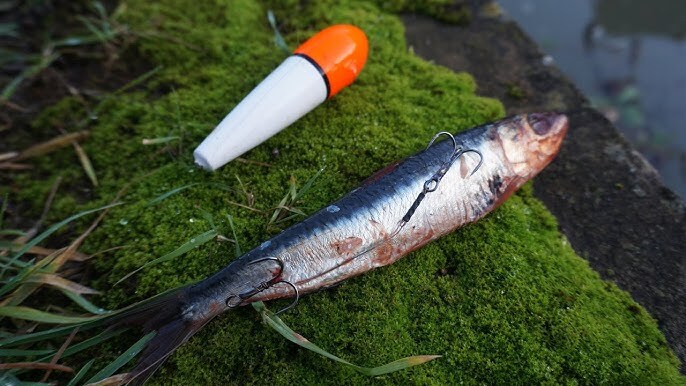
Sea baits — mackerel, sardine, herring and sprat — come straight from the fishmonger or the supermarket fish counter, and there is nothing wrong with buying them there. Smelt, lamprey and bluey come frozen from bait suppliers. Freeze everything individually on a tray before you bag it, so you can take out one bait at a time rather than chiselling a block apart on the bank.
We have left eel off the table on purpose. It is a traditional Fenland pike bait, but a national byelaw means you cannot take a rod-caught eel for bait, and the European eel is critically endangered. If you use eel at all, buy it from a legitimate supplier.
The best deadbaits for pike are rarely exotic: most pike anglers use two or three of these for an entire season. Smelt and mackerel in the freezer covers nearly every day you will fish.
What Size Trace for Each Deadbait?
Quick answer: match the treble size to the length of the bait — size 8 for 10–13cm baits, size 6 for 13–17cm, and size 4 for 16–20cm baits and half mackerel.
| Trace size | Gap between trebles | Bait length | Good for |
|---|---|---|---|
| Size 8 | 7cm | 10–13cm (4–5in) | Sprats, small roach, small smelt |
| Size 6 | 9cm | 13–17cm (5–6.5in) | Most smelt and roach |
| Size 4 | 11cm | 16–20cm (6–8in) | Half mackerel, herring, lamprey, larger silverfish |
Sizes and gaps from the Drennan E-Sox Bait Trace range.
The gap between the two trebles is what the size really buys you. It lets one treble sit towards the tail and one towards the head, so the hooks are where a pike's jaws close. Put a size 8 trace in a half mackerel and both trebles bunch into one end of the bait, which is how takes get missed.
Whatever you use, the Pike Anglers' Club minimums are simple: a wire trace every time, at least 45cm (18in) long, of 20lb or more, with barbless, semi-barbed or crushed-barb trebles. The Drennan E-Sox Semi-Barbed Bait Trace at £3.85 clears every one of them, with 46cm of 34lb wire. The Fox Rage Predator Twin Treble Trace at £6.99 is 52cm of 40lb 49-strand wire — check the trebles and crush any full barbs before you fish it.
The Club also recommends a wire up-trace of at least 60cm (24in) above the lead. A deadbait can tangle back up the line on the cast, and without an up-trace a pike that takes it there bites straight through your mainline.
How Do You Rig a Deadbait for Pike?
Quick answer: a straight leger for simplicity, a float leger to watch the take, and a popped-up leger over weed.
| Method | When to use it | Key kit |
|---|---|---|
| Straight leger | Wind, deep water, longer range | Running lead on a large-eye run ring, drop-off indicator |
| Float leger | Drains and stillwaters, when you want to see the take | Fox Rage Predator HD Deadbait Pencil, £4.29 |
| Popped-up leger | Over weed or bottom debris | Fox Rage Oil & Air Kit, £5.99, or Ledger Stems, £5.49 |
The straight leger is the simplest deadbait rig there is. The lead runs freely on a large-eye run ring above the up-trace, so a pike picking up the bait feels as little as possible, and it holds the bait in place when wind or undertow would drag a float away. On a snaggy bottom, attach the lead with a short link of weak nylon so it can break free.
The float leger adds a float set slightly over depth, which gives you a second, visual warning of a take. The Fox Rage Predator HD Deadbait Pencil is built for exactly this and will often lift on the bite; its top insert comes out to take a starlight for fishing into dark. It comes in Large and XL at £4.29.
The popped-up leger lifts the bait off the bottom so it sits above weed rather than buried in it. Inject the bait with air using the Fox Rage Oil & Air Kit — two syringes and three needles for £5.99, with the larger needle for adding fish oils — or use a buoyant Ledger Stem or the Camo Deadbait Pop-Up Weights at £5.49. Fox's own advice is that dead coarse fish pop up best.
Two rules apply to every one of these rigs. First, the lead must always be able to come free if the trace breaks: a fixed lead that cannot is a "tether rig", and a pike that snaps off towing one can die, so never clip a lead straight onto a trace swivel. Second, use at least 15lb mono or 30lb braid as your mainline, which is the Pike Anglers' Club minimum for bait fishing.
When Should You Strike on a Pike Deadbait?
Quick answer: early — at the first proper indication, not after a second run.
Every minute you wait gives the pike time to turn and swallow the bait. The old advice about letting a pike "run twice" is how deep-hooked pike happen, and a deep-hooked pike is one you may not be able to return safely. As soon as the line is moving and you are sure it is a take, wind down and strike.
That only works if you see the take the moment it happens, which is what a drop-off indicator is for. The PikePro Standard Drop Off Indicator at £9.99 holds the line in an adjustable ball clip, so you can set it to beat undertow, and it shows drop-backs — a pike swimming towards you and slackening the line — as well as runs. Pair it with an audible alarm and you will not miss either.
Never leave your rods. It is illegal in England and Wales to leave a rod and line unattended or out of your control, and with pike it is also dangerous: any rig left unwatched can end with a fish swallowing the bait unseen. If you need to walk away, reel in.
When and Where Should You Fish Deadbaits for Pike?
Quick answer: October to March, whenever the water is below 18°C, near features where prey fish gather.
The legal rule is simpler than people think. The coarse fish close season runs from 15 March to 15 June on rivers, streams and drains, while most stillwaters and canals are open all year, subject to local byelaws and fishery rules. Nothing in national law says pike fishing starts in October.
The October start is about the fish. The Pike Anglers' Club recommends not fishing for pike when the water is 18°C or above, because pike recover poorly from a fight in warm, oxygen-poor water and can die after release. Their warm-water guidance also warns that pike swallow baits faster in warm conditions, which is exactly what deadbaiting has to avoid.
Once the water has cooled, fish where the prey fish are. On drains that means bends, junctions and anywhere the roach shoals hole up for winter; on stillwaters it means margins, drop-offs and features. The Fenland drains a short drive north of us are classic deadbait water, and our guide to pike fishing for beginners covers reading a new water in more detail.
What Most Anglers Get Wrong
Quick answer: waiting too long to strike, and fishing for pike before the water has cooled.
- Waiting for the second run. This is the single biggest cause of deep-hooked pike. Strike at the first sure sign of a take.
- Starting in the September heat. The calendar says autumn, but the water may still be above 18°C. Check the temperature, not the date.
- Leaving the rods. It is illegal and it is how pike end up swallowing baits nobody saw them take. Drop-off on every rod, and stay with them.
- A short trace and no up-trace. Under 45cm is too short for a pike that engulfs the bait. Add a 60cm up-trace and a bite-off becomes almost impossible.
- Taking roach from one water to fish another. In England and Wales a fish you catch can only be used as bait on the same water, and many fisheries ban coarse deadbaits entirely. Sea baits from the fishmonger avoid the problem altogether.
What You Need for Pike Deadbaiting
Quick answer: semi-barbed traces, a drop-off on every rod, a proper deadbait rod, and full unhooking kit before your first cast.
- Traces and trebles — the Drennan E-Sox Semi-Barbed Bait Trace at £3.85 in sizes 4, 6 and 8, or tie your own with Drennan E-Sox Pike Trebles at £6.50 and trace wire.
- Drop-off indicators — one per rod. The PikePro Standard is £9.99.
- Pike floats — the Fox Rage Predator HD Deadbait Pencil at £4.29 for float legering.
- A deadbait rod — the Fox Predator Warrior 12ft 3.25lb Deadbait X at £74.99 is built for bigger waters and bigger pike. The full range is under predator rods.
- Braid or mono — the Westin W3 Deadbait 8-Braid at £34.99 comes in 43lb and 51lb, comfortably over the 30lb minimum. Fishing Line Explained covers the difference.
- A landing net — knotless, with arms of at least 36in, which is what the Pike Anglers' Club recommends.
- An unhooking mat — a pike should never go down on hard or rough ground.
- Forceps and side cutters — 10–12in forceps for the trebles, and strong cutters in case a hook has to be cut.
Prices correct as of September 2026 — check the product page for current pricing and availability.
If you have never unhooked a pike, read the Pike Anglers' Club's handling guide before your first session, and take someone who has done it. Pike season is also cold season, so the winter clothing guide is worth ten minutes before you go. For days when a moving bait suits better, see our pike lures guide.
FAQs
What is the best deadbait for pike?
Smelt is the best all-round deadbait for pike, with mackerel close behind when the water is coloured. Smelt has a strong, distinctive scent and suits most waters, while mackerel puts out a heavy oil trail that draws pike from further away. Lamprey is the one to use when you need a bait that survives a long cast.
Can I use supermarket fish as pike deadbaits?
Yes. Mackerel, sardines, herring and sprats from the fish counter catch pike just as well as branded bait packs. Freeze them individually on a tray before bagging them, so you can take out one at a time.
Can I use roach as a pike deadbait?
Yes, but only within the rules. In England and Wales you must not use a fish you have caught as bait unless you are using it on the same water you caught it from, and many fisheries ban coarse deadbaits altogether. Check the fishery rules before you take any to the bank.
What size trebles should I use for pike deadbaits?
Match them to the bait: size 8 for baits of 10–13cm, size 6 for 13–17cm, and size 4 for 16–20cm baits such as half mackerel or herring. Use barbless, semi-barbed or crushed-barb trebles, as the Pike Anglers' Club recommends for bait fishing.
How long should a pike trace be?
At least 45cm (18in) of wire of 20lb or more, according to the Pike Anglers' Club. They also recommend a wire up-trace of at least 60cm (24in) above the lead, so a pike cannot bite through the mainline. Ready-made bait traces such as the Drennan E-Sox, at 46cm, are built to that length.
When should I strike on a pike deadbait?
As soon as you have a sure indication, whether that is a run or a drop-back. Waiting for a second run gives the pike time to swallow the bait, and deep-hooked pike are the result. Fish with a drop-off indicator on every rod so you see the take the moment it happens.
What water temperature is too warm for pike fishing?
18°C. The Pike Anglers' Club recommends not fishing for pike when the water is 18°C or above, because pike recover poorly from a fight in warm, oxygen-poor water. That is the real reason most pike anglers wait until October.
Get the Freezer Stocked
Two baits in the freezer, a semi-barbed trace matched to their size, a drop-off on every rod and an early strike will catch you more pike this winter than any secret bait. Everything above is in the pike and predator range, and Pike Fishing for Beginners covers the rest if you have never landed one. If you would rather have the kit put in your hands, come and see us in Newmarket.