

Posted by Hooked Tackle on 22nd Aug 2026
Float Fishing for Beginners: Rigs, Shotting and Depth
By Hooked Tackle · Last updated 22 August 2026
We are a tackle shop in Newmarket. This is the rig we set up for people at the counter when they want to start on the float.
Quick Answer
A float holds your bait at a set depth and shows the bite. Start with a waggler, which attaches to the line at the bottom end only. Plumb the depth before you feed anything, because fishing at the wrong depth is the most common reason beginners blank. And fish closer in than you think — most commercial fishery fish are within two rod lengths of the bank.
What Is Float Fishing?
Quick answer: a buoyant float fixed to your line, weighted with split shot, holding the bait at a depth you choose.
The float carries shot that make it sit upright with only the coloured tip showing above the water. When a fish takes the bait, the float dips, slides away or disappears completely, and that is your bite.
It is the best method for a beginner to learn because everything is visible. You watch the float all session, you see fish moving through the swim, and you build a picture of what is happening under the water that a static rod tip never gives you. Nothing teaches you to read a swim faster.
There are three float types a UK coarse angler will meet. A waggler attaches at the bottom end only and is cast out with rod and line. A stick float attaches top and bottom and is mainly a river float. A pole float is fished on a pole with no reel involved — and of the three, the waggler is where you start.
One more name worth knowing: the pellet waggler is a short, thick, heavy waggler used for shallow carp fishing on commercials in summer. It is a specialist tool rather than a starting point.
You can catch almost every UK coarse fish on a float, and our guide to the species you will catch shows how to tell them apart.
The Tackle You Need
Quick answer: a float rod, a 3000 reel, some wagglers, a dispenser of split shot and a plummet.
- Float rod, 12–13ft — length gives you line control; drop to 10–11ft if you only fish close in. Browse float rods.
- Reel, 3000 size, loaded with 3–5lb mainline — lighter line than feeder fishing so the float behaves properly. See reels and mainline.
- Wagglers, 1.5g to 3g — a few of each covers close-in work, distance and windy days. Shop wagglers and pole floats.
- Split shot, sizes No8, No6, No4, BB and AAA — buy a dispenser with all five rather than single sizes.
- A plummet — a small weight that clips to the hook so you can find the depth. Get one with your split shot and plummets.
- Ready-tied hooks to nylon, sizes 18 to 14 — no knots to learn on your first session. See hooks to nylon.
- Landing net, disgorger and a bait tub — the net is compulsory at most fisheries. Browse landing nets and disgorgers and tools.
That is the whole float fishing tackle list, and if you already own a feeder setup you only need the floats, shot and a plummet to switch over. Our beginner tackle guide covers the wider kit. Anyone aged 13 or over also needs a valid Environment Agency rod licence.
Not sure which line to use? Our fishing line guide explains which mainline to use for float fishing, and why mono is the usual choice.
How to Set Up a Waggler Rig (Step by Step)
Quick answer: lock the float with shot either side of the eye, then spread the rest of the weight down the line.
This is how to set up a waggler rig from an empty spool.
- Thread the mainline through the eye at the bottom of the waggler. The line passes through the eye only; nothing else holds the float on.
- Lock the float with a shot either side of the eye. Use AAA or BB depending on what the float is rated to carry. Pinch them on gently so you can slide them later.
- Add the bulk shot two-thirds of the way down towards the hook. Three No6 grouped together is the standard starting point on a 2g float.
- Add two or three No8 droppers between the bulk and the hook. Space them evenly so the bait falls in a controlled way rather than dropping like a stone.
- Attach a ready-tied hooklength to a loop in the mainline. Loop to loop takes ten seconds and is strong enough for anything on a commercial.
- Plumb the depth before you cast a baited rig anywhere. This step is not optional and it comes before you feed.
The float should sit with only the coloured tip showing. If more than the tip is above the surface, add a No8; if the whole thing sinks, take one off. Getting this right is what makes bites obvious rather than ambiguous.
Shotting Patterns Explained
Quick answer: roughly 80% of the weight locks the float, and the remaining 20% is spread down the line towards the hook.
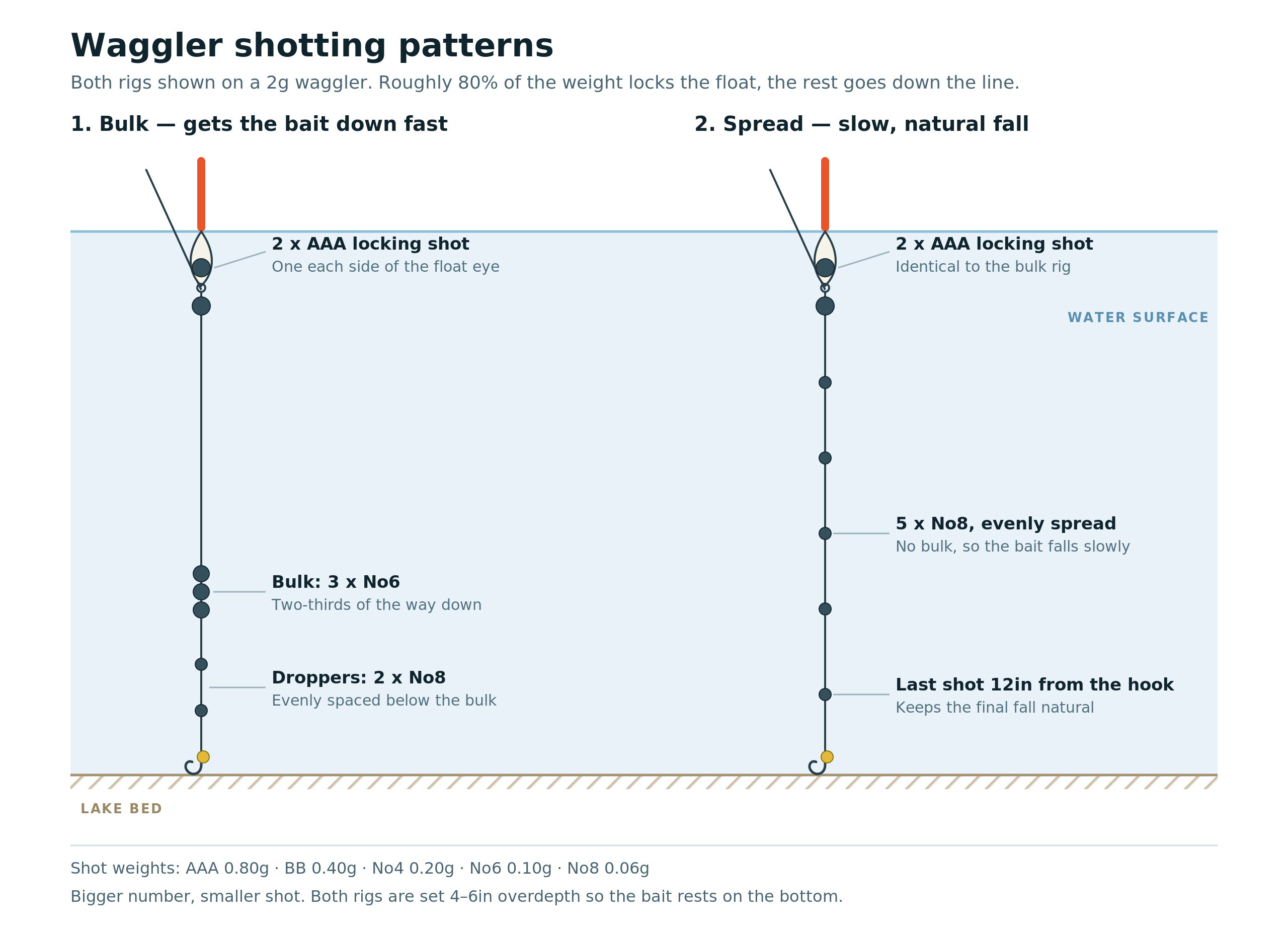
Shot sizes run from tiny No8 up through No6, No4, BB and AAA. As with hook sizes, the bigger the number the smaller the shot, which catches everyone out at first. Our hook sizes guide explains the same backwards logic on the hook side.
These shotting patterns are starting points that will catch fish on any UK commercial fishery.
| Float size | Locking shot | Bulk and droppers | Best for |
|---|---|---|---|
| 1.5g waggler | 1 x AAA + 1 x BB | 2 x No6 bulk, 2 x No8 droppers | Close-in work, calm days, silverfish |
| 2g waggler | 2 x AAA | 3 x No6 bulk, 2 x No8 droppers | The all-round starting choice |
| 3g waggler | 3 x AAA | 4 x No6 bulk, 3 x No8 droppers | Distance, wind, deeper water |
| Pellet waggler | Usually self-cocking | 1 x No8 only, or nothing at all | Shallow summer carp |
A slow-falling bait catches more fish on commercial fisheries, because carp and F1s spend a lot of time looking upwards. Spread the droppers out when fish are taking on the drop, and bunch them lower down when small fish are intercepting everything before it reaches the bottom.
Plumb the Depth Before You Do Anything Else
Quick answer: clip a plummet to the hook, cast to your spot, and slide the float up or down until only the tip shows.
- Attach the plummet to the hook. Most clip on and are held by a cork or rubber base.
- Cast to the exact spot you intend to fish and watch the float. If the float disappears the rig is too shallow; if it lies flat it is too deep.
- Slide the float up or down until the tip sits correctly, then remove the plummet. You now know the depth of your swim.
Nearly every beginner who blanks on the float is fishing at the wrong depth and has no idea. A bait suspended two feet off the bottom on a lake where the fish are grubbing about on the deck will be ignored for eight hours straight, and nothing else you change will fix it.
Set the rig four to six inches overdepth to start, so the bait rests on the bottom and the last dropper is just off it. If fish start swirling or you see them higher in the water, shallow up. Doing this properly means you are fishing deliberately rather than hoping.
Plumb again if you move swim, and plumb again if you change distance. Two rod lengths out and five rod lengths out are rarely the same depth.
How to Feed a Float Swim
Quick answer: little and often, and closer in than you think.
Feed a small pinch of bait every cast rather than a big pile at the start. A steady trickle keeps fish in the swim and hunting; one large helping fills them up and they drift off. Six maggots or eight micro pellets each cast is plenty.
On distance, most beginners cast too far out of pure instinct. Most fish on a commercial fishery are caught within two rod lengths of the bank, and a float fished at five metres will regularly out-fish one fished at thirty. Start close and only go further out if nothing happens.
Match the feed to the hookbait and keep it simple. Feed maggots and fish a maggot; feed pellets and fish a banded pellet. Our carp fishing guide goes further into feeding for bigger fish, and bait for a full session costs very little.
Little and often is also the key to catching silverfish in matches, where a steady trickle of bait keeps the bites coming all day.
Waggler or Pole: Which Should a Beginner Start With?
Quick answer: start with the waggler.
Waggler fishing is cheaper to get into, teaches you to cast, and works at any distance from the near shelf to the far bank. One rod, one reel and a handful of floats covers every commercial fishery in the country. It is also the skill that transfers to everything else you will fish later.
Pole fishing for beginners is a different proposition. A pole is far more accurate, brilliant for margins and F1s, and lets you place a bait to the inch. It is also a bigger outlay and a separate skill set including elastication, which is the shock-absorbing elastic threaded through the top sections. Browse poles and whips and pole elastic when you are ready.
A whip is the cheap middle ground — a short pole with the line tied straight to the tip, and genuinely good fun for silverfish. If the float does not suit you at all, our method feeder guide covers the other main way to fish a commercial.
Reading Bites on the Float
Quick answer: if the tip goes under and stays under, strike.
The confident sink. The tip slides away and does not come back. This is a fish that has taken the bait and turned, and it is the easiest bite in fishing to hit. Strike.
The dither and lift. The float wobbles then rises slightly in the water. That usually means a fish has taken the bait on the drop and lifted a dropper shot, taking weight off the float. Strike at this one too, because it is often a better fish.
Small knocks that never develop. Repeated tiny dips with nothing behind them are almost always small fish pecking at a bait too big for them. Either ignore them and wait, or go down a hook and bait size and start catching them deliberately.
The float sliding sideways. A fish has taken the bait and is moving off with it without pulling the float under. Treat this exactly like a proper bite and strike.
On striking technique, sweep the rod sideways rather than lifting it straight up. It picks up line far faster across the surface, and it does not fire your rig into the tree behind you when you miss.
FAQs
What is the best float for a beginner?
A 2g waggler is the best all-round starting float for UK commercial fisheries. It casts comfortably, sits steady in a light wind and suits everything from roach to carp. Buy two or three in case you lose one, and add a 1.5g and a 3g once you have got the hang of it.
How deep should I set my float?
Set it four to six inches overdepth so the bait rests on the bottom. Find the depth first by plumbing up with a plummet rather than guessing. If fish start showing higher in the water, shallow the rig up until you find them.
What is a waggler?
A waggler is a float attached to the line at the bottom end only, held in place by split shot either side of the eye. It is cast out with a rod and reel and is the standard float for stillwaters and commercial fisheries. The name covers a whole family of floats, from slim insert wagglers to thick pellet wagglers.
How much shot do I need on a waggler?
Roughly 80% of the float's rating goes around the float to lock it, and the remaining 20% goes down the line. On a 2g waggler that means two AAA locking shot, three No6 as bulk and two No8 droppers. Most shotting patterns are variations on that same split.
How far out should a beginner fish a float?
Start within two rod lengths of the bank. Most fish on a commercial fishery are caught far closer in than beginners expect, and accuracy matters much more than distance. Only fish further out if the close swim produces nothing after an hour.
Is float fishing better than feeder fishing?
Neither is better; they suit different days. The float is more engaging, better in shallow or close water, and teaches you more about what fish are doing. The feeder is better at distance, in wind, and when you want to sit on one spot and build a bed of bait.
Do I need a pole to fish a float?
No. A waggler fished on a normal float rod and reel covers everything a beginner needs. A pole is more accurate for close-in work but costs considerably more and involves a separate set of skills.
Get Kitted Out
Float fishing for beginners comes down to three things: fish a waggler, plumb up before you feed, and feed little and often close in. Get those right and the rest follows on its own. Browse our float fishing range, or come into the shop in Newmarket and we will set a rig up with you.